By Reproducing, organisms perpetuate and protect their kind from extinction. Social insects such as honey bees can reproduce new individuals within the colony unit, but this is not sufficient for their continued survival. If bees were to maintain themselves solely by producing young, their colonies- without human intervention- would decrease as a result of mites, disease, fire, predators, or adverse environmental conditions.
Honey bee colonies perpetuate themselves by swarming. Swarming is a natural process of reproduction at the colony level. A colony divides, and part of it leaves for a new homesite, usually with the old queen, while the remaining members continue at the original site with newly emerged- and later mated- queen. In this manner, a single unit becomes two.
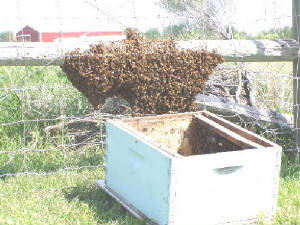
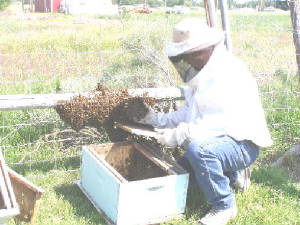
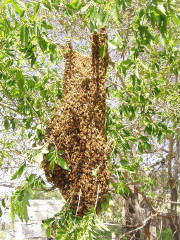
An abundance of queen cells, often called swarm cells, indicates that swarming preparations are under way. Shortly after the swarm cells are sealed, the colony will cast a swarm. Bees will exit as a swarm with the old queen, on any warm, windless day, usually between 9:00 am and 3:00 pm (earlier or later if the weather is favorable). Occasionally, bees will alight on a nearby object and begin fanning with their scent glands exposed to attract the remainder of the swarm and the queen. Soon a "cluster" of bees forms. It is this cluster- readily visible to the casual observer- that is correctly called the swarm (see our photos on this page). Scout bees will then dance on the cluster to communicate a new homesite. When one has been agreed on (within a few hours to a few days), the swarm flies to the new site, guided by scenting bees.
Bees in a swarm are usually quite gentle. Before leaving their old hive, they engorge honey, which seems to contribute to their gentleness. Another reason for their gentleness might be that, because the homeless cluster is only a temporary situation, the division of labor- including guarding- that prevails in a normal hive is either nonexistent or not as prevalent.